
How to Read a Pitch Report: Red vs Black Soil Guide 2026
To learn how to read a pitch report, examine the surface rather than relying on one label such as “red soil” or “batting pitch.” Check the grass, moisture, hardness, cracks, recent use, weather and expected dew together. The match format and the condition of the actual strip matter more than a venue’s old average score.
This guide explains each clue in plain language. It also shows how red-soil and black-soil pitches can behave, what to watch for at the toss, and how to turn a report into sensible player-type decisions without treating any prediction as guaranteed.
Quick answer: cricket pitch clues
- Visible grass: may help the new ball seam, especially when the surface also contains moisture.
- Hard, dry surface: usually offers truer pace and bounce early, but it can wear later.
- Tacky or damp surface: can make the ball stop, grip or arrive at an uneven pace.
- Dust and widening cracks: increase the chance of grip, turn and variable bounce.
- Heavy dew: can make the ball slippery, although at some venues it may also become heavy.
- Best evidence: the live pitch inspection and team comments are more useful than generic venue history.
Last fact-checked: 10 August 2026.
What Does a Cricket Pitch Report Actually Tell You?
A pitch report is an informed assessment of how the prepared strip may affect pace, bounce, seam, spin and scoring. It is not a promise about the result. The same ground can use several strips, and preparation can change from one match to the next.
Under MCC Law 6, the ground authority selects and prepares the pitch before the match. That is why “this venue is always high-scoring” is a weak conclusion unless the current strip supports it.
When learning how to read a pitch report, separate observation from prediction. “There is an even covering of live grass” is an observation. “Fast bowlers will take every wicket” is an unsupported prediction.
How to Read a Pitch Report in 7 Steps
1. Identify the surface colour and soil
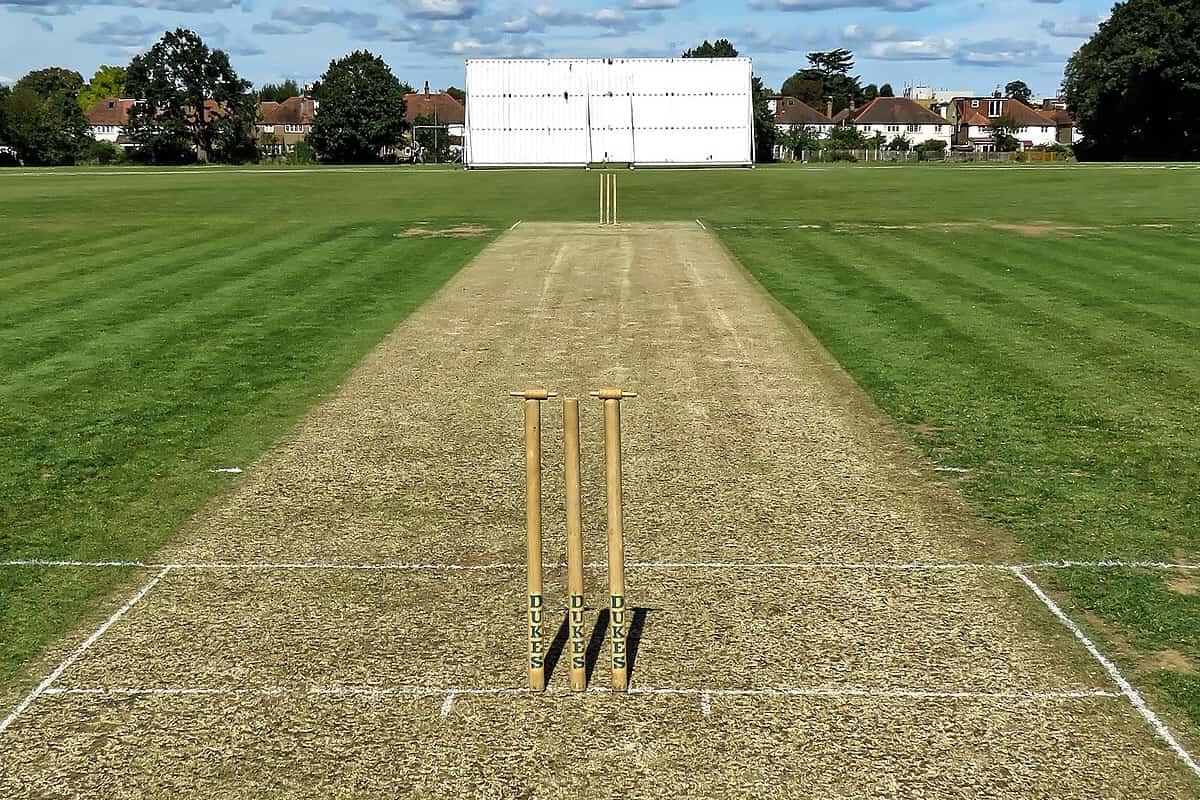
Colour is a starting clue, not the final verdict. Grounds may use red, black or mixed local soils, and their clay content, binding, rolling and moisture can differ. Red soil is generally more porous and can dry faster; blacker, clay-rich material may retain moisture and bind longer. Preparation can still reverse the simple stereotype.
A hard red-soil strip may produce pace and bounce. The same strip, once dry and worn, may offer spinners sharp turn and bounce. A black-soil strip can be slow when moisture remains, but a well-rolled, firm black surface can still bat well.
2. Look at the amount and condition of grass
Do not stop at “green pitch.” Ask whether the grass is live or dry, long or shaved, and evenly distributed or patchy.
- Live, even grass with moisture: can preserve the surface and assist seam movement.
- Dry or dead grass: may simply hold the pitch together and have less effect on movement.
- Patchy grass: can contribute to inconsistent pace or bounce if the underlying areas differ.
Cloud cover may help swing conditions, but swing also depends on the ball, bowler, wind and humidity. Grass mainly affects what happens after the ball lands.
3. Check moisture and tackiness
A surface can look dry on top while retaining moisture below. Listen for words such as tacky, slightly damp, holding or two-paced. These suggest the ball may not come onto the bat at a consistent speed.
On a tacky pitch, bowlers who use cutters, cross-seam deliveries and changes of pace may become more relevant. However, the surface may quicken as it dries, so the first and second innings need not behave alike.
4. Judge hardness and expected bounce
Commentators often test the surface with a key or describe how firmly it has been rolled. A hard, compact pitch normally gives better carry and more predictable bounce. That can help stroke-play, but it also rewards fast bowlers who hit the deck hard.
A softer surface may absorb more energy, producing slower pace or lower bounce. “Hard” does not automatically mean batter-friendly; combine it with grass, moisture and boundary conditions.
5. Inspect cracks, dust and previous wear
Fine hairline cracks before play are not automatically dangerous. Their importance depends on whether they widen, crumble or create loose material as the match progresses. Dust at the surface and worn footmarks can help spin, especially in longer formats.
Also ask whether the strip has been used recently. A reused or tired pitch is more likely to be slow or worn than a fresh strip at the same venue.
6. Add weather and dew
Sun, heat and wind can dry a pitch; rain and humidity can slow drying. Dew deserves special care. It may make the ball slippery and difficult to grip, but its effect is not identical everywhere. In an ICC press conference, Pat Cummins explained that dew can make the ball heavy in some conditions and slippery in others.
Therefore, “win the toss and always chase” is not a reliable rule. Check the evening forecast, start time, outfield moisture and comments from captains or ground staff.
7. Adjust for the match format
A small amount of early movement can dominate a short T20 phase but be only one chapter of a Test match. In limited-overs cricket, batting intent, field restrictions and boundary placement can outweigh modest pitch assistance. In multi-day cricket, deterioration and footmarks matter much more.
How to Read a Pitch Report: Red Soil vs Black Soil
| Feature | Red-soil tendency | Black-soil tendency | What to verify |
|---|---|---|---|
| Drying | Often more porous and quicker to dry | May retain moisture for longer | Recent rain, covers and preparation |
| Early pace | Can offer pace and bounce when hard | Can be slower if moisture remains | Hardness, grass and moisture |
| Spin | Can turn and bounce when dry or worn | Can grip when dry, tacky or worn | Dust, cracks, wear and footmarks |
| Batting | True bounce can suit confident stroke-play | Firm rolling can still create a sound batting pitch | Current strip, not soil colour alone |
Bottom line: red does not mean “pace only,” and black does not mean “spin only.” The Mumbai Cricket Association’s pitch-preparation guidance notes differences in binding and porosity, but match behaviour still depends on preparation and conditions.
How to Read a Pitch Report for Player Types
If your goal is to understand how to read a pitch report for team selection, convert each clue into a player type, not a guaranteed name.
| Observed clue | Possible effect | Player types to consider |
|---|---|---|
| Live grass plus moisture | New-ball seam and movement | Accurate new-ball seamers; technically strong top-order batters |
| Hard surface with good carry | True bounce and value for shots | Hit-the-deck fast bowlers and boundary-scoring batters |
| Tacky or two-paced surface | Ball may hold in the pitch | Cutters, slower-ball specialists and patient batters |
| Dry, dusty or worn strip | Grip, turn or variable bounce | Skilled spinners and batters strong against spin |
| Heavy evening dew expected | Possible grip problem or heavier ball | Death bowlers with yorker control; chasing batters if conditions genuinely ease |
Confirm the final XI, batting order, workload, injuries and role after the toss. A perfect pitch read cannot help if the selected player is not playing or has a limited role.
How to Read a Pitch Report Without Misusing Average Scores
Venue averages can provide context, but they often combine different seasons, strips, team strengths, formats and boundary settings. They may also be distorted by a few extreme matches.
Use recent comparable matches only after answering four questions:
- Was the same format played?
- Was the same or a nearby strip used?
- Were weather and dew conditions similar?
- Were the boundary ropes placed similarly?
MCC Law 19 states that the umpires determine the boundary before the toss and it remains fixed for that match. This means a venue’s published boundary dimensions are not necessarily the exact dimensions for today’s game.
How to Read a Pitch Report Before and After the Toss
Before the toss
- Check whether the strip is fresh or reused.
- Note soil colour, grass coverage, moisture, hardness, cracks and dust.
- Check rain, temperature, humidity, wind and dew forecasts.
- Compare only recent matches played in similar conditions.
After the toss
- Listen to both captains’ reasons; they may reveal unexpected moisture or expected dew.
- Confirm playing XIs and each player’s likely role.
- Update the likely new-ball, middle-over and death-over match-ups.
- Do not force a “chasing advantage” if the evidence is weak.
Common Mistakes When Learning How to Read a Pitch Report
- Red soil equals pace: a worn red-soil pitch can also help spin.
- Black soil equals spin: rolling and moisture can produce a stable batting surface.
- Dry means instant turn: some dry pitches remain hard and true before wearing.
- Dew guarantees a successful chase: dew intensity and its effect vary.
- Every strip at a venue is identical: grounds use multiple prepared strips.
- Historical average is today’s par score: team strength and match conditions change.
- Boundary size is permanent: rope placement can differ between matches.
Match-Day Pitch Report Checklist
- What colour and soil type is visible?
- Is the grass live, dead, even or patchy?
- Is the surface damp, tacky, dry or dusty?
- Does it look hard and tightly rolled?
- Are there cracks, footmarks or signs of reuse?
- What do the weather and dew forecasts show?
- Which format is being played, and how long must the pitch last?
- What did the captains say at the toss?
- Are the playing XIs and roles confirmed?
If you can answer these questions, you understand how to read a pitch report far better than someone relying on “red equals pace” or “win toss, chase.”
Examples and Related Pitch Guides
- Wankhede Stadium Pitch Report: Red Soil and Toss Guide
- Galle International Stadium Pitch Report 2026
- Rajiv Gandhi International Cricket Stadium Guide
- All CricSensei Pitch Reports
Frequently Asked Questions
What does a green cricket pitch mean?
A green pitch has visible grass, but the effect depends on whether that grass is live, dense and supported by moisture. Those conditions can assist seam movement. Dry or dead grass may mainly protect and bind the surface.
Which is better: red soil or black soil?
Neither is automatically better. Red soil often dries faster and may offer pace and bounce when hard; black soil may retain moisture longer. Preparation, grass, hardness, weather and wear decide how either surface actually plays.
Does red soil help fast bowlers or spinners?
It can help both at different stages. A hard red-soil pitch may reward pace and bounce early. As it dries and wears, it can also offer spinners turn and bounce.
How does dew affect a cricket pitch?
Dew mainly affects the ball and outfield. It can make the ball slippery and difficult to grip, but in some conditions it can become heavier. The effect varies by venue and night, so dew is not an automatic guarantee that chasing will be easier.
Should I trust a venue’s historical average score?
Use it only as background. The current strip, format, team strength, weather, boundary placement and recent use are more relevant than a long-term average combining different conditions.
What should I check before selecting a fantasy team?
Check the live pitch report, toss, confirmed XI, batting order, bowling roles, workload, injuries, weather and dew. Use pitch clues to identify suitable player types, but never treat a fantasy outcome as guaranteed.
Sources and Method
CricSensei prioritises the Laws of Cricket, cricket associations and official match commentary. Where pitch behaviour depends on preparation or weather, this guide states the limitation instead of presenting a universal rule.
- MCC Law 6: The Pitch
- MCC Law 19: Boundaries
- Mumbai Cricket Association: Preparation of a Cricket Pitch
- ICC: Pat Cummins discusses how dew can affect the ball
For a practical example of how surface wear, moisture and spin influence a Test venue, explore our SSC Colombo pitch and Test records guide.
Conclusion
The best way to learn how to read a pitch report is to combine evidence. Soil colour gives context, while grass, moisture, hardness, cracks, weather, format and recent use reveal how the current strip may behave. Treat every clue as a probability, update your view after the toss, and avoid absolute rules.
Responsible-play note: This article is educational and does not guarantee fantasy-sports results. Fantasy contests may involve financial risk. Follow local laws, age restrictions and platform rules, and never stake money you cannot afford to lose.




4 Comments