
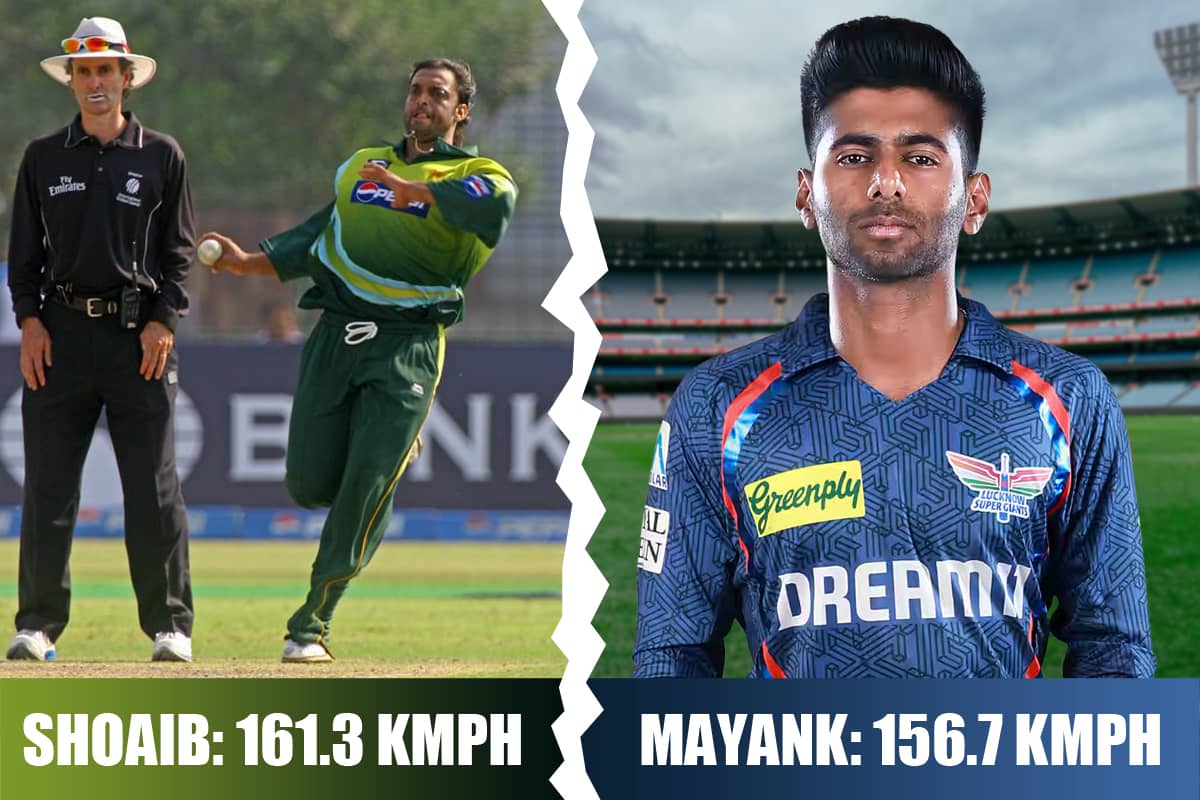
Fastest Ball in Cricket History: 161.3 km/h Record & Top 10
Shoaib Akhtar bowled the fastest ball in cricket history: 161.3 km/h (100.23 mph). The Pakistan fast bowler produced the delivery against England at Newlands, Cape Town, during the 2003 ICC Cricket World Cup on 22 February 2003. It remains the fastest electronically measured delivery widely accepted in men’s cricket.
Bowling-speed lists need one important qualification: cricket has not always used identical speed guns, camera systems or measurement points. The 161.3 km/h benchmark is well documented, but some older and lower-ranked figures are better described as reported readings rather than entries in one perfectly standardised official database.
Quick answer: Cricket’s fastest deliveries
- Fastest recorded ball: Shoaib Akhtar — 161.3 km/h (100.23 mph)
- Fastest ball in Test cricket: Mitchell Starc — 160.4 km/h
- Fastest ball in IPL history: Shaun Tait — 157.71 km/h
- Fastest Indian delivery in IPL history: Umran Malik — 157.0 km/h
- Fastest recorded ball in women’s cricket: Shabnim Ismail — 132.1 km/h
Records last fact-checked: 2 August 2026.
Top 10 Fastest Balls Ever Recorded in Cricket
The following table ranks the most widely reported peak speeds in men’s cricket. It includes modern match readings and clearly labels the two legacy measurements that were recorded using older methods.
| Rank | Bowler | Speed | Opponent / Context | Venue | Year |
|---|---|---|---|---|---|
| 1 | Shoaib Akhtar | 161.3 km/h 100.23 mph | England, ODI World Cup | Newlands, Cape Town | 2003 |
| 2= | Shaun Tait | 161.1 km/h 100.10 mph | England, ODI | Lord’s, London | 2010 |
| 2= | Brett Lee | 161.1 km/h* 100.10 mph | New Zealand, ODI | Napier | 2005 |
| 4 | Jeff Thomson | 160.6 km/h† 99.79 mph | Legacy fast-bowling study | WACA, Perth | 1975–76 |
| 5 | Mitchell Starc | 160.4 km/h 99.67 mph | New Zealand, Test | WACA, Perth | 2015 |
| 6 | Andy Roberts | 159.5 km/h† 99.11 mph | Australia / legacy reading | WACA, Perth | 1975 |
| 7 | Fidel Edwards | 157.7 km/h 97.99 mph | South Africa | Wanderers, Johannesburg | 2003 |
| 8 | Mitchell Johnson | 156.8 km/h 97.43 mph | England, Test | MCG, Melbourne | 2013 |
| 9= | Mohammad Sami | 156.4 km/h 97.18 mph | Zimbabwe | Sharjah | 2003 |
| 9= | Shane Bond | 156.4 km/h 97.18 mph | India, ODI World Cup | Centurion | 2003 |
* Brett Lee’s peak is commonly listed as 161.1 km/h, although a contemporary match report recorded 160.8 km/h. † Thomson and Roberts were measured with legacy methods, so their figures are not directly comparable with every modern broadcast-radar reading.
Who Bowled the Fastest Ball in Cricket History?
Shoaib Akhtar holds the benchmark with a delivery measured at 161.3 km/h, or 100.23 mph. He bowled it to England opener Nick Knight in Pakistan’s World Cup group match at Newlands on 22 February 2003.
The ICC’s report based on host-broadcaster data lists Akhtar at 161.3 km/h and Brett Lee at 160.7 km/h during the group stage. Guinness World Records also lists Akhtar’s delivery as the highest electronically measured speed for a cricket ball.
The figure is often described as the “official world record,” but there is a useful nuance: the ICC has historically noted that speed-gun systems are not uniform everywhere. The most precise wording is that Akhtar’s delivery is the widely accepted fastest electronically measured ball in cricket.
The Bowlers Who Came Closest
Shaun Tait — 161.1 km/h
Shaun Tait came within 0.2 km/h of Akhtar’s mark while bowling for Australia against England at Lord’s in 2010. His fifth ball to Craig Kieswetter was displayed at 100.1 mph, equivalent to approximately 161.1 km/h. Tait’s slinging action produced extraordinary speed but also placed heavy demands on his body.
Brett Lee — reported at 161.1 km/h
Brett Lee’s fastest widely cited reading came against New Zealand at Napier in 2005. Many later record summaries list 161.1 km/h, while the contemporary ESPNcricinfo match coverage reported 160.8 km/h. Lee also crossed 160 km/h during the 2003 World Cup, demonstrating that his pace was not based on one isolated display.
Jeff Thomson — 160.6 km/h in a legacy study
Jeff Thomson’s 160.6 km/h figure came from a fast-bowling study at the WACA in the mid-1970s. He was measured with older high-speed technology rather than the modern live broadcast setup used for Akhtar, Tait and Starc. Thomson was unquestionably one of cricket’s quickest bowlers, but his figure should carry a methodology label rather than being treated as perfectly like-for-like.
Mitchell Starc — 160.4 km/h
Mitchell Starc delivered a 160.4 km/h yorker to Ross Taylor in the second Test between Australia and New Zealand at Perth in November 2015. The ICC match report described it as the fastest recorded delivery in Test cricket.
Other reported members of the Top 10
Andy Roberts, Fidel Edwards, Mitchell Johnson, Mohammad Sami and Shane Bond complete the widely circulated Top 10. Their peak readings range from 159.5 to 156.4 km/h. Because historical records are fragmented, CricSensei reports these figures with context instead of presenting them as measurements from one universal system.
Why Fastest-Ball Lists Sometimes Disagree
Readers may see Brett Lee listed at 160.8 or 161.1 km/h, older bowlers moved up or down, or a suspiciously high number disappear after a match. These differences usually come from one of four causes:
- Different technology: Older photo-sonic studies and modern Doppler radar do not measure in exactly the same way.
- Measurement point: A ball is fastest near release and slows as it travels. A reading taken later cannot be compared directly with release speed.
- Calibration and alignment: Radar position and angle can affect the displayed number.
- Rounding or broadcast errors: A television graphic can occasionally display or label an incorrect speed.
For this reason, the top five are better documented than many positions below them. A trustworthy list should disclose uncertainty instead of turning every decimal into an unquestionable fact.
Fastest Ball in IPL History
Shaun Tait holds the accepted IPL record at 157.71 km/h for Rajasthan Royals in 2011. Lockie Ferguson, Umran Malik, Mayank Yadav and Anrich Nortje complete the established top five.
| Rank | Bowler | Team | Speed | Year |
|---|---|---|---|---|
| 1 | Shaun Tait | Rajasthan Royals | 157.71 km/h | 2011 |
| 2 | Lockie Ferguson | Gujarat Titans | 157.3 km/h | 2022 |
| 3 | Umran Malik | Sunrisers Hyderabad | 157.0 km/h | 2022 |
| 4 | Mayank Yadav | Lucknow Super Giants | 156.7 km/h | 2024 |
| 5 | Anrich Nortje | Delhi Capitals | 156.22 km/h | 2020 |
Sportstar reported that Ferguson bowled at 157.3 km/h in the 2022 final, overtaking Umran Malik’s earlier 157.0 km/h delivery that season. Mayank Yadav reached 156.7 km/h in 2024, while Anrich Nortje recorded 156.22 km/h in 2020.
Why Gerald Coetzee’s reported 157.4 km/h ball is excluded
A broadcast display initially attributed a 157.4 km/h delivery to Gerald Coetzee during IPL 2024. Subsequent competition graphics omitted it, and reports explained that the speedometer reading was erroneous. Mayank Yadav’s 156.7 km/h delivery therefore remained the recognised fastest ball of IPL 2024. A temporary screen reading should not be added to an all-time table without later verification.
Who Bowled the Fastest Ball by an Indian?
Umran Malik holds the record for the fastest Indian delivery in IPL history at 157.0 km/h. He reached that speed for Sunrisers Hyderabad against Delhi Capitals on 5 May 2022. Mayank Yadav is next at 156.7 km/h for Lucknow Super Giants in 2024.
This article deliberately uses the phrase “in IPL history.” Claims about the fastest Indian across every international, domestic and training environment are difficult to compare because not every match has used the same tracking system.
Fastest Ball in Test Cricket
Mitchell Starc’s 160.4 km/h delivery against New Zealand in Perth in 2015 is regarded as the fastest ball recorded in Test cricket. Ross Taylor defended the yorker during an innings in which he eventually scored 290.
Starc’s reading was questioned at the time because several nearby deliveries were much slower, which again illustrates why speed records need context. Nevertheless, ICC and Cricket Australia match reports retain the 160.4 km/h figure.
Fastest Ball in Women’s Cricket
Shabnim Ismail bowled the fastest recorded delivery in women’s cricket at 132.1 km/h (82.08 mph). Playing for Mumbai Indians against Delhi Capitals in the Women’s Premier League on 5 March 2024, the former South Africa pacer became the first woman recorded above 130 km/h.
The ICC confirmed Ismail’s 132.1 km/h record. Keeping the men’s and women’s categories separate makes the answer clear and prevents misleading comparisons.
How Is Bowling Speed Measured?
Modern broadcasts normally calculate bowling speed near the point where the ball leaves the hand. Two technologies are commonly involved:
- Doppler radar: A radar signal reflects from the moving ball and estimates its speed. Position and alignment matter.
- Optical tracking: Multi-camera systems such as Hawk-Eye reconstruct the ball’s path and calculate movement between frames.
The displayed number is generally the ball’s initial or near-release speed, not its speed after pitching or when it reaches the batter. Air resistance and contact with the pitch reduce speed during flight.
A 2025 peer-reviewed study comparing cricket ball-speed systems noted that radar readings can be affected by positioning, alignment and the cosine effect. This explains why small disagreements between sources do not automatically mean that a bowler or broadcaster acted improperly.
Fast-Bowling Myths and Speed-Gun Errors
Has anyone bowled at 175 or 176 km/h?
No delivery at that speed has been accepted as the men’s cricket record. Extremely high viral readings are usually caused by a graphic, tracking or labelling error. A claim should be supported by the match context and a reliable governing-body or broadcaster record before it replaces Akhtar’s benchmark.
Did Jeff Thomson bowl at 180 km/h?
Thomson and people who faced him believed he might have registered much faster under modern release-point measurement. That is an interesting argument, but it is not the same as an electronically verified 180 km/h match delivery. His documented legacy figure should be presented separately from modern radar records.
Does the fastest bowler always take the most wickets?
No. Raw speed reduces a batter’s reaction time, but elite bowling also depends on accuracy, seam movement, swing, bounce, changes of pace and tactical control. A single peak-speed ball does not measure the quality of an entire spell or career.
Sources and Verification Method
CricSensei prioritised governing-body reports, competition archives and contemporary match coverage. Where credible sources disagree, the difference is disclosed rather than silently choosing the higher figure.
- ICC: Akhtar and Lee’s recorded speeds at the 2003 World Cup
- Guinness World Records: Fastest delivery of a cricket ball
- ICC: Mitchell Starc’s 160.4 km/h Test delivery
- Cricket Australia: Starc and the 160 km/h club
- Fox Sports Australia: Historical Top 10 speed list
- Sportstar: Lockie Ferguson’s 157.3 km/h delivery in IPL 2022
Related Cricket Records
- Fastest Century in Cricket History
- Fastest Century in T20 Cricket
- Longest Six in Cricket History
- How to Read a Cricket Pitch Report
Frequently Asked Questions
Who bowled the fastest ball in cricket history?
Shoaib Akhtar bowled the widely accepted fastest electronically measured delivery: 161.3 km/h against England at the 2003 World Cup in Cape Town.
How fast was Shoaib Akhtar’s fastest ball in mph?
It was measured at 100.23 mph, commonly rounded to 100.2 mph.
Has anyone bowled faster than 161.3 km/h?
No faster delivery has been accepted under comparable top-level match conditions. Higher viral readings have not displaced Akhtar’s recognised benchmark.
Who bowled the fastest ball in Test cricket?
Mitchell Starc bowled a delivery measured at 160.4 km/h against New Zealand at Perth in 2015.
What is the fastest ball in IPL history?
Shaun Tait holds the accepted IPL record with a 157.71 km/h delivery for Rajasthan Royals in 2011.
Who bowled the fastest IPL ball by an Indian?
Umran Malik bowled the fastest Indian delivery in IPL history at 157.0 km/h for Sunrisers Hyderabad in 2022.
Who bowled the fastest ball in women’s cricket?
Shabnim Ismail holds the women’s record with a 132.1 km/h delivery for Mumbai Indians in the 2024 Women’s Premier League.
Conclusion
Shoaib Akhtar’s 161.3 km/h delivery remains the fastest ball in cricket history under widely accepted electronic measurement. Shaun Tait and Brett Lee came closest, while Mitchell Starc owns the Test benchmark at 160.4 km/h. In the IPL, Shaun Tait leads at 157.71 km/h, Umran Malik holds the Indian IPL mark at 157.0 km/h, and Shabnim Ismail holds the women’s record at 132.1 km/h.
The numbers are exciting, but their measurement context matters. Cricket fans—and search engines—are better served by a sourced record with a clear caveat than by a spectacular number copied without verification.

2 Comments