
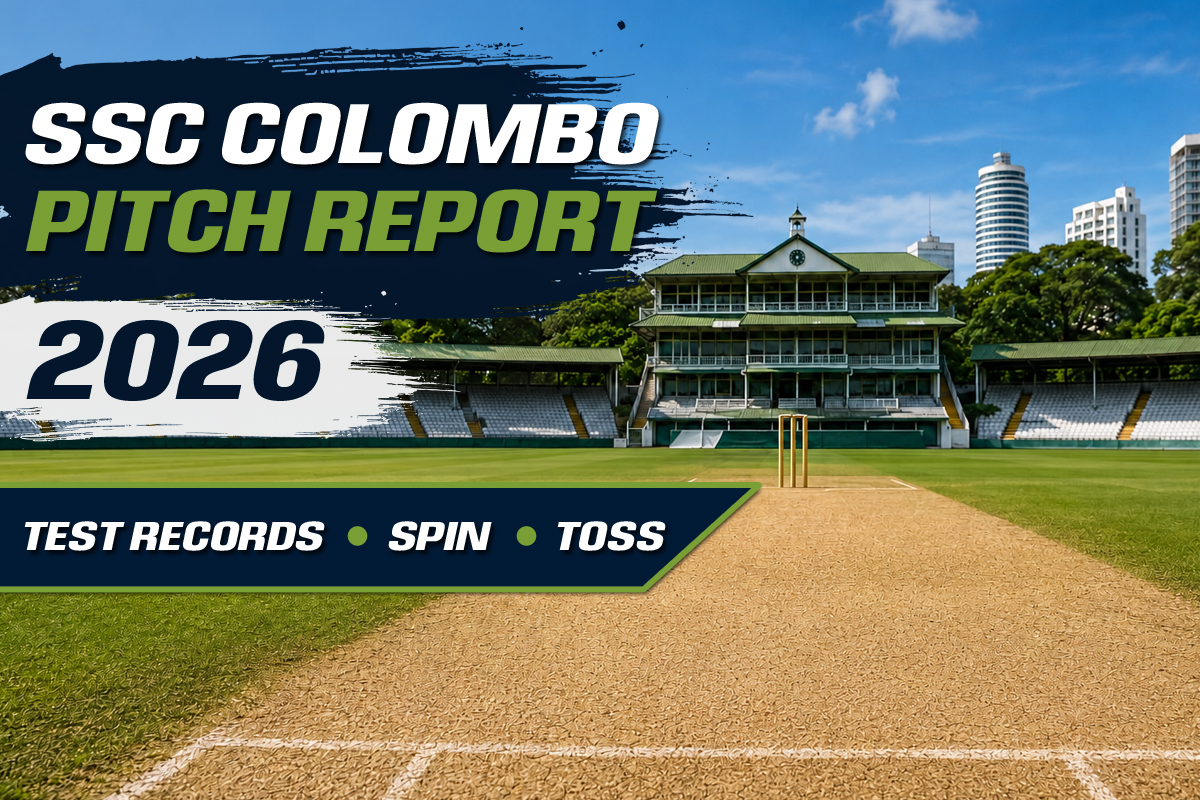
Sinhalese Sports Club Ground Pitch Report 2026: Test Guide
The Sinhalese Sports Club Ground pitch report for 2026 points to a surface that can reward batting during the first half of a Test before spin and variable bounce become more influential. However, the result depends on the selected strip, moisture, grass cover, weather and how quickly the surface deteriorates.
The SSC Ground in Colombo will host the second Sri Lanka vs India Test from 23–27 August 2026. This guide compares the venue’s historical records with its most recent completed Test, helping readers understand what to check before making a match or fantasy-cricket decision.
Quick answer: SSC Colombo pitch report
- Early match: Generally suitable for patient batting when the surface is firm.
- New ball: Seamers can find movement if there is moisture or live grass.
- Later match: Spinners become more dangerous as the surface dries and wears.
- First-innings average: Approximately 323 runs in Tests.
- Highest Test total: Sri Lanka’s 756/5 declared against South Africa in 2006.
- 2026 Test: Sri Lanka vs India, 23–27 August.
Records and schedule last fact-checked: 14 August 2026.
Sinhalese Sports Club Ground at a Glance
| Detail | Information |
|---|---|
| Venue | Sinhalese Sports Club Ground |
| Location | Colombo, Sri Lanka |
| Common name | SSC Ground or Maitland Place |
| Primary format covered here | Test cricket |
| Upcoming Test | Sri Lanka vs India, 23–27 August 2026 |
| Historical character | Good for batting early; increasing assistance for spin as the pitch wears |
Sinhalese Sports Club Ground Pitch Report 2026
The SSC surface should not automatically be described as either a permanent batting paradise or a guaranteed turning track. Its historical scoring figures show that batters can occupy the crease for long periods, particularly when the pitch is firm and the ball has stopped moving.
As a Test progresses, footmarks, dryness and general wear can create more turn and uneven bounce. This usually increases the importance of accurate spin bowling, but fast bowlers can remain effective through reverse swing, changes of pace and the second new ball.
Days 1 and 2: Best time for batting
A hard surface can provide consistent bounce during the opening two days. Once the new-ball movement fades, top-order batters who defend patiently and rotate the strike may have the best opportunity to build a substantial innings.
If the strip contains visible moisture or a meaningful covering of live grass, seamers may receive assistance during the opening session. Therefore, the match-day surface should be inspected before assuming that batting first is automatically correct.
Days 3 and 4: Spin becomes more influential
The pitch may begin to dry and show signs of wear during the middle of the Test. Spinners who vary their pace and consistently attack the stumps can become more difficult to negotiate. Batting is still possible, but mistakes against turn and changing bounce become more expensive.
Day 5: Greater risk of turn and uneven bounce
A fifth-day SSC pitch may contain wider cracks, rough areas and significant footmarks. Chasing a large target can become difficult, especially when an experienced spin attack can maintain pressure around the bat.
This remains a historical pattern rather than a guarantee. Rain, pitch preparation and interruptions can slow deterioration and keep the surface playable for longer.
What the Most Recent SSC Test Tells Us
The most recent completed Test at the ground, Sri Lanka against Bangladesh in June 2025, provides a useful example of how conditions can change.
- Bangladesh scored 247 in the first innings.
- Sri Lanka replied with 458, led by Pathum Nissanka’s 158.
- Bangladesh were then dismissed for 133.
- Left-arm spinner Prabath Jayasuriya took 5/56 in the second innings.
- Sri Lanka won by an innings and 78 runs.
Sri Lanka Cricket described the track as largely batting-friendly until the third day. The match nevertheless demonstrated that both pace and spin can contribute: Sri Lanka’s seamers caused damage in Bangladesh’s first innings before spin became more decisive later.
SSC Colombo Test Records and Average Scores
The following figures cover the venue’s completed Test history through June 2025. Statistical databases can vary slightly when they update averages, so the innings averages should be treated as useful historical benchmarks rather than predicted scores.
| Record | SSC Test figure |
|---|---|
| Tests played | 46 |
| Average first-innings score | Approximately 323 |
| Average second-innings score | Approximately 354 |
| Average third-innings score | Approximately 273 |
| Average fourth-innings score | Approximately 182 |
| Highest team total | Sri Lanka 756/5 declared vs South Africa, 2006 |
| Lowest team total | Sri Lanka 81 vs England, 2001 |
| Highest successful chase | Sri Lanka 326/5 vs Zimbabwe, 1998 |
| Highest individual score | Mahela Jayawardene 374 vs South Africa, 2006 |
| Best innings bowling | Rangana Herath 9/127 vs Pakistan, 2014 |
The Historic 624-Run Test Partnership
The ground hosted one of Test cricket’s most important batting records in 2006. Mahela Jayawardene scored 374 and Kumar Sangakkara made 287 as the pair added 624 runs for the third wicket against South Africa.
It remains the highest partnership for any wicket in men’s Test cricket. Sri Lanka declared on 756/5 and won the match by an innings and 153 runs. The performance demonstrates how rewarding the SSC surface can be for batters who survive the early stages and remain disciplined for long periods.
India vs Sri Lanka Test History at SSC Colombo
India’s most recent Test at the SSC Ground was the second Test of the 2017 series. India scored 622/9 declared, with Cheteshwar Pujara and Ajinkya Rahane making centuries. Sri Lanka replied with 183 and 386, and India won by an innings and 53 runs.
That match also showed the venue’s changing nature. India’s batters constructed a huge first-innings total before Ravindra Jadeja and the visiting attack exploited the surface and scoreboard pressure.
India vs Sri Lanka second Test, 2026
- Dates: 23–27 August 2026
- Venue: Sinhalese Sports Club Ground, Colombo
- Series: ICC World Test Championship 2025–27
This schedule has been confirmed by the ICC and Sri Lanka Cricket. The final pitch assessment should be made after viewing the prepared strip closer to the toss.
What Should the Toss Winner Do at SSC?
Batting first is generally the safer historical strategy when the surface is dry and firm. It allows a team to use the best batting conditions and potentially make its opponent bat last against a deteriorating pitch.
However, bowling first may be reasonable when:
- The strip contains visible moisture.
- There is dense, live grass rather than dry grass.
- Cloud cover and humidity are expected to assist swing.
- Rain has affected preparation.
- The team has a strong seam attack capable of exploiting the first session.
The toss decision should therefore combine the historical SSC pattern with the live pitch, weather forecast and balance of the two teams.
Which Player Types Can Succeed at SSC?
Top-order batters
Technically sound batters who leave the ball well and remain patient against the new ball can benefit once movement reduces. Converting a start into a long innings is particularly valuable at this venue.
Fast bowlers
Seamers may be most dangerous with the new ball or when moisture is present. Reverse swing and the second new ball can keep them involved even after the surface becomes slower.
Spin bowlers
Spinners often become more important from the middle of the match. Accuracy, changes of pace and the ability to attack rough areas can be more useful than relying only on dramatic turn.
Wicketkeepers and close fielders
Changing bounce and bat-pad opportunities can create additional catching chances as the surface wears. Sharp close catching may become decisive during the third and fourth innings.
Match-Morning Pitch Checklist
Before using any Sinhalese Sports Club Ground pitch report for a final decision, check:
- Surface colour: Is the strip pale and dry or darker with visible moisture?
- Grass: Is it live and upright or dry and rolled into the pitch?
- Hardness: A firm surface usually provides more reliable early bounce.
- Cracks and footmarks: Existing wear can bring spin into the match earlier.
- Weather: Cloud, humidity and rain can change new-ball behaviour.
- Team selection: The number and quality of seamers and spinners matter.
- Toss comments: Listen for information about moisture, preparation and expected deterioration.
For a detailed explanation of this process, read our How to Read a Cricket Pitch Report guide.
Related Pitch Reports
- Galle International Stadium Pitch Report 2026
- Wankhede Stadium Pitch Report: Red Soil and Toss Guide
- More CricSensei Pitch Reports
Frequently Asked Questions
Is the Sinhalese Sports Club Ground a batting or bowling pitch?
The SSC Ground has historically offered good batting conditions during the early part of a Test. Seamers can benefit from initial moisture, while spinners normally become more influential as the surface dries and wears.
What is the average first-innings score at SSC Colombo?
The historical Test first-innings average is approximately 323 runs. It is a reference figure, not a guaranteed par score for every match.
What is the highest Test score at the SSC Ground?
Sri Lanka’s 756/5 declared against South Africa in 2006 is the venue’s highest Test total. Mahela Jayawardene’s 374 in that match is the highest individual Test score at the ground.
Does the SSC pitch help spinners?
Yes, spin often becomes more important as the Test progresses. However, the ground is not automatically a turning pitch from the first session, and its behaviour depends on preparation, moisture and wear.
Should the toss winner bat first at SSC Colombo?
Batting first is generally sensible on a dry, firm surface because batting may become harder later. Bowling first can still be justified when moisture, live grass and overcast conditions offer substantial assistance to seamers.
When is the India vs Sri Lanka Test at SSC in 2026?
The second Test between Sri Lanka and India is scheduled at the Sinhalese Sports Club Ground in Colombo from 23–27 August 2026.
Sources and Verification
- ICC: India’s 2026 Test series schedule in Sri Lanka
- Sri Lanka Cricket: India tour of Sri Lanka 2026
- Sri Lanka Cricket: SSC Test result against Bangladesh in 2025
- ICC: Mahela Jayawardene’s 374 and the 624-run partnership
- ICC: India’s 2017 Test victory at SSC Colombo
- India Today: SSC Colombo venue records and statistics
For the upcoming Test, use this Sinhalese Sports Club Ground Pitch Report alongside the latest weather, confirmed playing XIs and match-day pitch inspection rather than relying only on historical averages.
Final Verdict
The most reliable Sinhalese Sports Club Ground pitch report is conditional rather than absolute. The venue has historically rewarded long batting innings, but its recent Test also demonstrated that seamers can make early breakthroughs and spinners can dominate after the surface begins to wear.
On a dry, firm strip, batting first is likely to be attractive. If moisture, live grass or overcast weather is present, the opening session may favour seam bowling. Always combine the historical record with the live pitch assessment before making a final decision.



3 Comments