
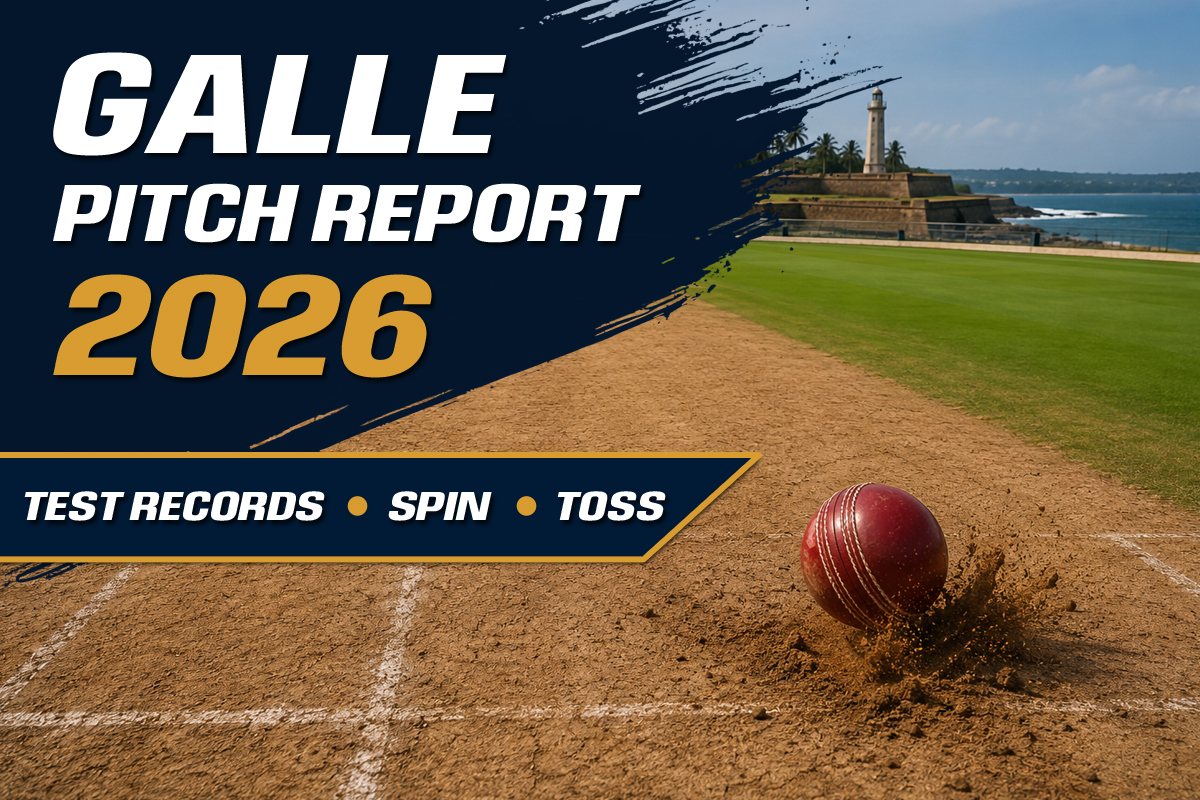
Galle International Stadium Pitch Report 2026: Test Guide
The Galle International Stadium pitch report for 2026 points to a surface where batting can be productive early, but spin normally becomes increasingly influential as the Test progresses. However, Galle should not automatically be labelled a low-scoring or spin-only venue. The same ground has produced totals above 600 as well as dramatic batting collapses.
The condition of the selected strip, recent weather, surface moisture and deterioration during the match matter more than one historical average. This guide explains how the pitch usually behaves, what the records show and what to watch during the India vs Sri Lanka Test beginning on 15 August 2026.
Quick answer: Galle International Stadium pitch report
- General character: Batting-friendly when fresh, with increasing assistance for spin as the surface wears.
- Best batting period: Usually the earlier part of the match if the strip is dry and firm.
- Main bowling threat: Finger spin, variation in pace and deliveries using the developing rough.
- Fast-bowler opportunity: The new ball and humid or overcast periods.
- Toss preference: Batting first is often attractive, but the actual surface and rain forecast must be checked.
Last fact-checked: 13 August 2026. Venue records are based on completed Tests before the 2026 India–Sri Lanka match.
India vs Sri Lanka Test 2026 at Galle
The first Test of India’s 2026 tour of Sri Lanka is scheduled at Galle International Stadium from 15 to 19 August 2026. The second Test will be played at the Sinhalese Sports Club in Colombo from 23 to 27 August. Both matches form part of the ICC World Test Championship cycle.
| Match detail | Information |
|---|---|
| Match | Sri Lanka vs India, First Test |
| Dates | 15–19 August 2026 |
| Venue | Galle International Stadium, Galle |
| Format | Men’s Test cricket |
| Competition | ICC World Test Championship 2025–27 |
According to the latest official squad updates, India have included spin options such as Ravindra Jadeja, Kuldeep Yadav, Manav Suthar and Saransh Jain. Sri Lanka’s first-Test squad includes Prabath Jayasuriya, Ramesh Mendis and off-spinner Keshara Nuwantha.
These are squad selections rather than a confirmed playing XI. The final teams should be checked after the toss before making match or player assessments.
How Does the Galle Pitch Usually Behave?
The Galle pitch can change significantly across five days. It often begins firmer and becomes more difficult to bat on as footmarks, rough areas and surface wear develop. The rate of deterioration is not identical in every Test.
Day 1: New-ball movement followed by batting opportunity
Fast bowlers may find some movement with the new ball, particularly when there is cloud cover or moisture on the surface. If batters survive this period, the pitch can allow confident stroke play while it remains firm.
Spinners can still be used on the opening day, but the amount of turn depends on how dry the selected strip is. A dry surface can produce visible dust or grip earlier than expected.
Days 2 and 3: Spin becomes more important
As the pitch dries, the ball may begin to grip and turn more consistently. Bowlers who can vary their speed, trajectory and release angle become difficult to attack. Batters need to use their feet carefully and avoid playing only from the crease.
Day two is not automatically the easiest batting day. A well-prepared surface can remain reliable, while a dry strip may already show deterioration.
Days 4 and 5: Rough, turn and variable bounce
The later stages are generally the hardest for batting. Footmarks outside the batters’ off stump can provide targets for spinners, and some deliveries may turn sharply while others travel straighter.
Variable bounce can be as dangerous as the turn itself. Fourth-innings run chases therefore become difficult when the surface has deteriorated, although weather interruptions can reduce the time available to force a result.
Is Galle a Batting Pitch or a Bowling Pitch?
The most accurate answer is that Galle can reward both batting and spin bowling at different stages of the same Test.
The venue’s record total of 704/3 declared proves that substantial scores are possible on a good surface. Australia also scored 654/6 declared at Galle in January 2025. At the other extreme, South Africa were dismissed for 73 in 2018.
That variation is why a Galle International Stadium pitch report should consider the actual match strip instead of describing every Galle wicket as identical.
- Firm and dry strip: Good initial batting conditions, with spin becoming stronger later.
- Very dry or previously used strip: Turn may appear much earlier.
- Moist or overcast conditions: Seam and swing can become more relevant.
- Heavy rain interruptions: Surface moisture and reduced playing time may change the normal match pattern.
Galle International Stadium Test Records
The following records provide useful historical context. They should not be treated as predicted scores for the 2026 Test.
| Record | Performance | Details |
|---|---|---|
| Completed Tests before 2026 match | 49 | From June 1998 to June 2025 |
| Highest team total | 704/3 declared | Sri Lanka vs Ireland, 2023 |
| Lowest team total | 73 | South Africa vs Sri Lanka, 2018 |
| Highest individual Test score | 333 | Chris Gayle vs Sri Lanka, 2010 |
| Best innings bowling | 7/46 | Muttiah Muralitharan vs England, 2003 |
| Most Test runs at the ground | 2,382 | Mahela Jayawardene |
| Most Test wickets at the ground | 111 | Muttiah Muralitharan |
The enormous difference between the highest and lowest totals shows why one fixed “par score” can be misleading. The strength of the batting line-up, match situation and age of the pitch all influence the total.
What Is a Good First-Innings Score at Galle?
A first-innings score of approximately 350 or more can create a competitive foundation in many Galle Tests, but it is not a guaranteed winning score. On a flat surface, teams have crossed 500 and even 600. On a rapidly deteriorating pitch, a total closer to 300 may become extremely valuable.
Instead of relying only on a historical average, examine:
- Whether the surface appears dry or contains visible moisture
- The amount of grass left on the pitch
- How much the ball grips during the opening session
- Whether deliveries are producing uneven bounce
- The forecast for rain and prolonged cloud cover
- The number and quality of spinners selected by each team
Our detailed guide explains how to read a cricket pitch report without relying on one venue statistic.
What Should the Toss Winner Do?
Batting first is generally the safer Test-match option at Galle when the surface is dry and the weather allows five days of play. It gives a team the opportunity to score before the pitch experiences substantial wear and potentially forces the opposition to bat last.
However, the decision should not be automatic. A captain may consider bowling first if the surface contains moisture, the morning is heavily overcast or rain has affected preparation. The final decision should be based on the match-day pitch rather than the ground’s reputation alone.
Toss checklist: Check the surface colour, visible cracks, grass cover, recent rain, humidity and selected bowling attacks before making a final conclusion.
Which Players and Skills Suit the Galle Pitch?
Finger spinners
Accurate finger spinners are often the most influential bowlers at this venue. Left-arm orthodox bowlers can attack right-handed batters from over or around the wicket, while off-spinners can use rough created by fast bowlers.
Batters who play spin confidently
Successful batters need a clear method against spin. Sweeps, controlled use of the feet, soft hands and strike rotation can prevent the bowler from settling into one line.
Fast bowlers with a strong new-ball method
Galle is associated with spin, but fast bowlers still have an important role. Early movement, reverse swing and cutters can create chances. Pace bowlers also contribute by creating footmarks that spinners can target later.
All-rounders
Players who can contribute with both disciplined spin and lower-order batting become valuable as the pitch changes. Their second skill can help balance the playing XI without weakening either department.
India’s Previous Test at Galle
Before the 2026 series, India’s most recent Test at Galle was played in July 2017. India scored 600 in the first innings and won by 304 runs. Shikhar Dhawan and Cheteshwar Pujara scored centuries, while India’s bowlers maintained control across both Sri Lankan innings.
The result demonstrates that visiting teams can succeed at Galle by building a large first-innings total and selecting an attack capable of taking 20 wickets. However, a match from 2017 cannot determine how the 2026 strip will behave.
Weather and Coastal Conditions
Galle is a coastal venue, so humidity, cloud cover and passing showers can influence the match. Moisture may help the new ball move, while interruptions can slow the deterioration of the pitch or reduce the time available for a fourth-innings chase.
Weather forecasts can change quickly. Check the latest forecast again on the morning of the match rather than relying on a forecast published several days earlier.
Sources and Fact-Checking Method
This Galle International Stadium pitch report uses official series announcements and established cricket record databases. Historical records were checked against completed Test data available before the 2026 match.
- BCCI: India tour schedule and original Test squad
- BCCI: Updated India squad for the Sri Lanka Test series
- ICC: Sri Lanka squad for the first Test
- ESPNcricinfo: Galle International Stadium overview
- ESPNcricinfo: Highest Test totals at Galle
- ESPNcricinfo: Lowest Test totals at Galle
Frequently Asked Questions
Is Galle International Stadium a spin pitch?
Galle generally becomes favourable for spin as a Test progresses, particularly when the surface is dry. However, batting can be productive early, and fast bowlers may receive new-ball assistance in humid or overcast conditions.
What is the highest Test total at Galle?
Sri Lanka’s 704/3 declared against Ireland in 2023 is the highest Test innings total recorded at Galle International Stadium.
What is the lowest Test total at Galle?
South Africa’s 73 against Sri Lanka in 2018 is the lowest completed Test innings total at the venue.
Should the toss winner bat first at Galle?
Batting first is often preferred on a dry Galle surface because batting may become harder later. The captain should still assess moisture, grass cover and the weather before deciding.
Do fast bowlers get help at Galle?
Fast bowlers can find movement with the new ball and may also use cutters or reverse swing. Spin normally becomes the more consistent threat as the surface deteriorates.
When is the India vs Sri Lanka Test at Galle in 2026?
The first Test is officially scheduled at Galle International Stadium from 15 to 19 August 2026.
After the Galle Test, the series moves to SSC Colombo for the second Test from 23–27 August 2026. Read our Sinhalese Sports Club Ground Pitch Report for pitch behaviour, Test records, spin conditions and toss trends.
Final Verdict
The Galle International Stadium pitch report suggests a changing Test surface rather than a simple spin-only wicket. Batters can score heavily while the pitch is firm, but disciplined spin, developing rough and variable bounce can make the later innings much harder.
For the 2026 India–Sri Lanka Test, examine the live surface, weather and confirmed playing XIs before making a final match assessment. Historical records provide context, but the selected strip will determine how quickly spin enters the contest.
For another venue comparison, read the Wankhede Stadium pitch report, which explains how red soil, pace and dew can produce a very different match pattern.

4 Comments