
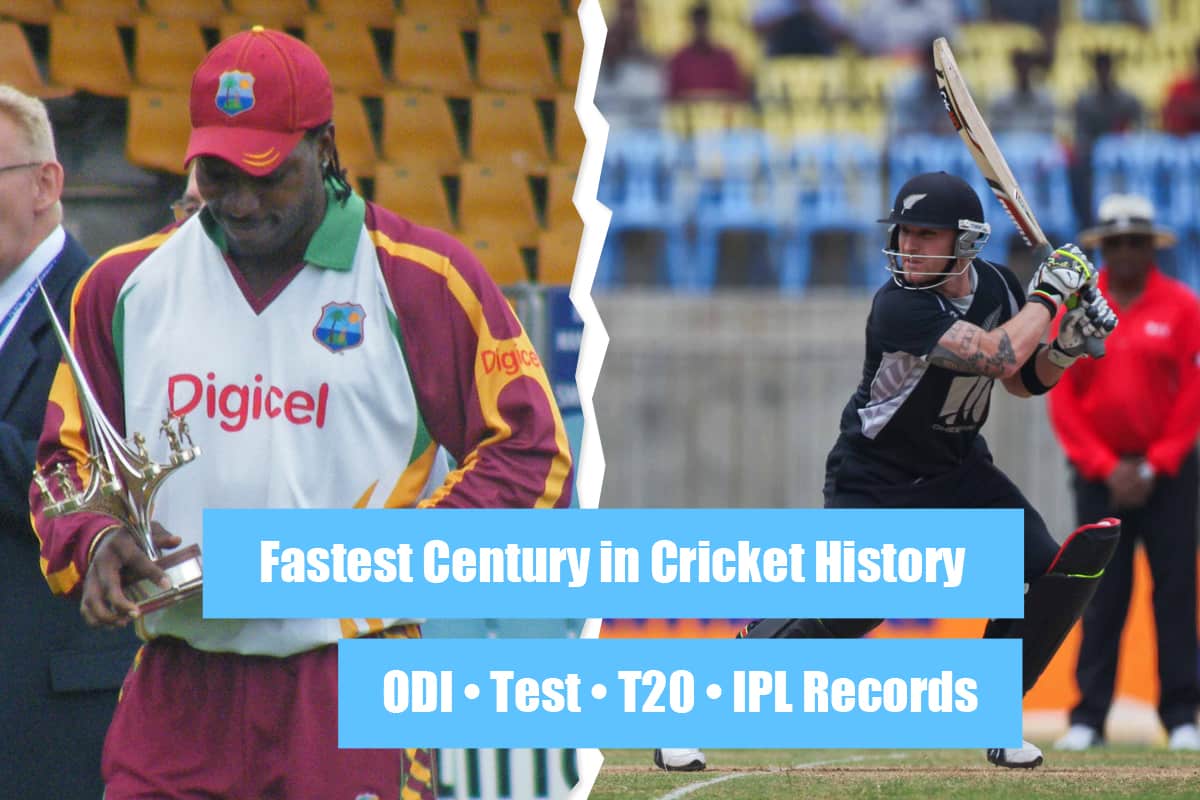
Fastest Century in Cricket History: 27-Ball Record & Fastest 100s by Format
Among officially recognised men’s international matches, Sahil Chauhan holds the fastest century in cricket history. He reached 100 from just 27 balls for Estonia against Cyprus on 17 June 2024. The record is separated by format, so Test, ODI, T20I and IPL centuries each have their own leader.
This guide compares the fastest men’s hundreds by balls faced and explains the match behind each record. It covers men’s international cricket and the IPL; women’s records are a separate category.
Quick answer: Fastest century by format
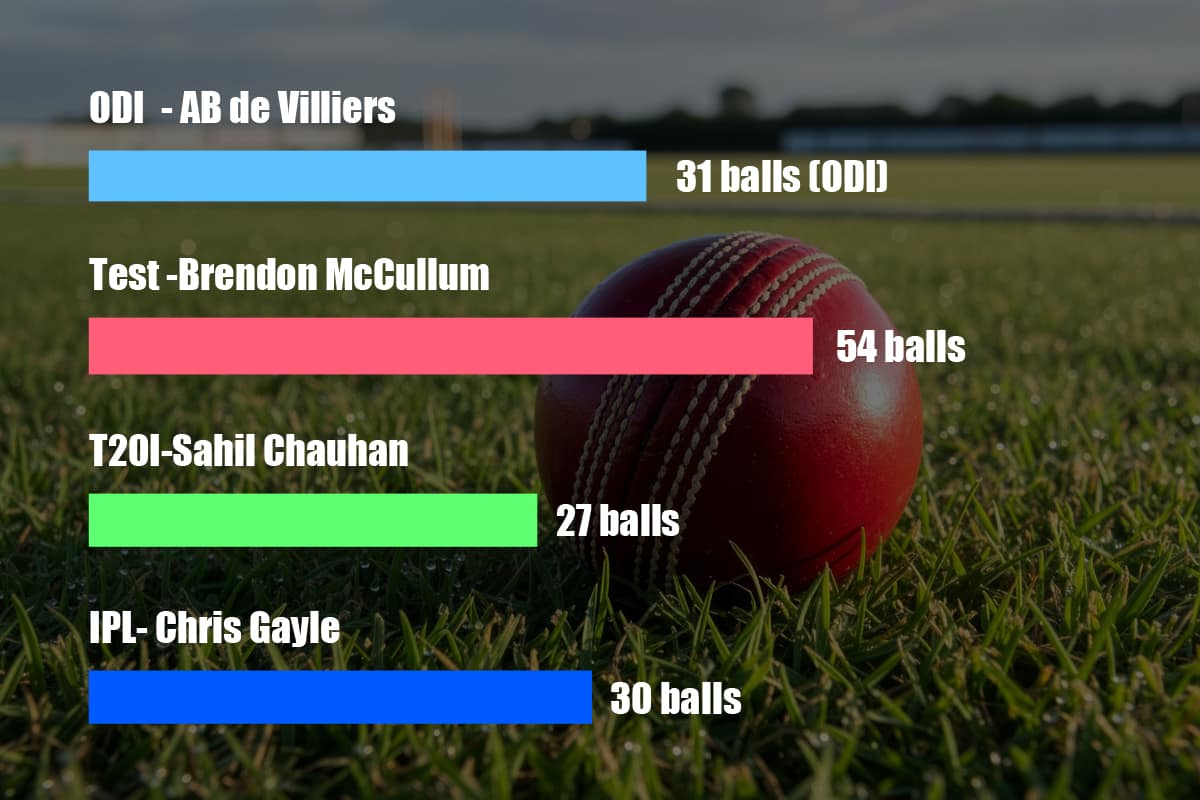
- Fastest men’s T20I century: Sahil Chauhan — 27 balls
- Fastest ODI century: AB de Villiers — 31 balls
- Fastest Test century: Brendon McCullum — 54 balls
- Fastest IPL century: Chris Gayle — 30 balls
Records last fact-checked: 1 August 2026.
Fastest Century in Cricket History: Records by Format
| Category | Player | Balls to 100 | Innings | Opposition | Year |
|---|---|---|---|---|---|
| Men’s T20I | Sahil Chauhan | 27 | 144* from 41 | Cyprus | 2024 |
| ODI | AB de Villiers | 31 | 149 from 44 | West Indies | 2015 |
| Test | Brendon McCullum | 54 | 145 from 79 | Australia | 2016 |
| IPL | Chris Gayle | 30 | 175* from 66 | Pune Warriors India | 2013 |
Who Scored the Fastest Century in Cricket History?
Sahil Chauhan scored the fastest century in men’s international cricket, reaching 100 from 27 balls. Playing for Estonia against Cyprus, he finished unbeaten on 144 from 41 deliveries, including 18 sixes. Estonia successfully chased 192 in the match.
The ICC confirmed Chauhan’s 27-ball hundred as the fastest men’s T20I century. It surpassed the previous 33-ball T20I record.
When someone asks for the fastest century in all cricket, the competition level must be stated. Unofficial matches, exhibition games and local leagues do not always use the same record standards. This article therefore uses recognised men’s international matches and official IPL records.
How Is the Fastest Century Measured?
A fastest century is ranked by the number of legal deliveries a batter faces before reaching 100 runs. It is not measured by total batting time, final strike rate or the total balls faced at the end of the innings.
- Balls to reach 100: The primary ranking measurement.
- Format: Tests, ODIs, T20Is and franchise leagues maintain separate records.
- Official match status: The match must be recognised by the relevant governing body or competition.
- Tied records: Two players can share a position when they reach 100 from the same number of balls.
Fastest T20I Century
Sahil Chauhan — 27 balls
Sahil Chauhan’s innings for Estonia against Cyprus on 17 June 2024 is the fastest century in men’s T20I cricket. He scored 144 not out from 41 balls at a strike rate of 351.21. His innings contained six fours and 18 sixes.
| Rank | Player | Balls to 100 | Team | Opposition | Year |
|---|---|---|---|---|---|
| 1 | Sahil Chauhan | 27 | Estonia | Cyprus | 2024 |
| 2= | Sikandar Raza | 33 | Zimbabwe | Gambia | 2024 |
| 2= | Jan Nicol Loftie-Eaton | 33 | Namibia | Nepal | 2024 |
For a wider comparison that includes domestic T20 competitions, see our fastest century in T20 guide.
Fastest ODI Century
AB de Villiers — 31 balls
AB de Villiers holds the men’s ODI record after reaching his century from 31 balls against the West Indies at Johannesburg on 18 January 2015. He finished with 149 from 44 balls, hitting nine fours and 16 sixes.
The ICC record report confirms that de Villiers broke Corey Anderson’s previous 36-ball ODI record.
Top five fastest men’s ODI centuries
| Rank | Player | Balls to 100 | Opposition | Year |
|---|---|---|---|---|
| 1 | AB de Villiers | 31 | West Indies | 2015 |
| 2 | Corey Anderson | 36 | West Indies | 2014 |
| 3 | Shahid Afridi | 37 | Sri Lanka | 1996 |
| 4 | Asif Khan | 41 | Nepal | 2023 |
| 5 | Mark Boucher | 44 | Zimbabwe | 2006 |
Fastest Test Century
Brendon McCullum — 54 balls
Brendon McCullum reached 100 from 54 balls against Australia at Christchurch on 20 February 2016. Playing his final Test, the New Zealand captain scored 145 from 79 balls after his team had slipped to 32 for 3.
The ICC match report confirms that McCullum improved on the 56-ball record jointly held by Viv Richards and Misbah-ul-Haq.
Top five fastest men’s Test centuries
| Rank | Player | Balls to 100 | Opposition | Year |
|---|---|---|---|---|
| 1 | Brendon McCullum | 54 | Australia | 2016 |
| 2= | Viv Richards | 56 | England | 1986 |
| 2= | Misbah-ul-Haq | 56 | Australia | 2014 |
| 4 | Adam Gilchrist | 57 | England | 2006 |
| 5 | Jack Gregory | 67 | South Africa | 1921 |
See the expanded historical rankings in our fastest Test centuries guide.
Fastest IPL Century
Chris Gayle — 30 balls
Chris Gayle holds the IPL record with a 30-ball century for Royal Challengers Bengaluru against Pune Warriors India on 23 April 2013. He went on to score 175 not out from 66 balls, which remains the highest individual score in IPL history.
Gayle’s record survived another major challenge when Vaibhav Suryavanshi reached 100 from 35 balls in 2025. The ICC’s IPL record summary identifies Gayle’s 30-ball hundred as the competition record.
Fastest centuries in IPL history
| Rank | Player | Balls to 100 | Team | Opposition | Year |
|---|---|---|---|---|---|
| 1 | Chris Gayle | 30 | RCB | Pune Warriors India | 2013 |
| 2 | Vaibhav Suryavanshi | 35 | RR | Gujarat Titans | 2025 |
| 3= | Yusuf Pathan | 37 | RR | Mumbai Indians | 2010 |
| 3= | Heinrich Klaasen | 37 | SRH | KKR | 2025 |
| 5 | David Miller | 38 | Kings XI Punjab | RCB | 2013 |
| 6 | Travis Head | 39 | SRH | RCB | 2024 |
Why the Records Are Different by Format
A 27-ball century in a T20I and a 54-ball century in a Test are both records, but they happen under very different conditions:
- T20Is and the IPL: Batters attack immediately because an innings lasts only 20 overs.
- ODIs: Batters must balance acceleration with the demands of a 50-over innings.
- Tests: There are no fielding restrictions after an early phase, bowlers can set defensive fields, and the red ball may swing or seam for longer.
This is why the fairest answer to “Who has the fastest century?” identifies both the player and the format.
Common Fastest-Century Confusion
Is Chris Gayle’s 30-ball hundred still the fastest?
It remains the fastest century in IPL history. It is not the fastest men’s international century because Sahil Chauhan reached 100 from 27 balls in a T20I.
Does the final innings strike rate decide the record?
No. The record is determined by how many balls the batter faced before reaching exactly 100 runs. What happens after the century does not change the number of balls taken to reach it.
Can unofficial matches be included?
Claims from exhibition, local or unrecognised matches should not be mixed with official international or IPL records unless the competition and data source are clearly identified.
Sources and Verification Method
CricSensei checked the record claims against current ICC reports and established score databases. Direct sources:
- ICC: Sahil Chauhan’s 27-ball T20I century
- ICC: AB de Villiers’ 31-ball ODI century
- ICC: Brendon McCullum’s 54-ball Test century
- ICC: Fastest IPL centuries
- ESPNcricinfo: Fastest Test hundreds by balls faced
- ESPNcricinfo: Fastest ODI hundreds
- ESPNcricinfo: Fastest IPL hundreds
Related Cricket Records
- Fastest Century in T20: Full List
- Fastest Test Centuries
- Fastest Ball in Cricket History
- Longest Six in Cricket History
Frequently Asked Questions
Who scored the fastest century in cricket history?
Among officially recognised men’s international matches, Sahil Chauhan holds the record. He reached 100 from 27 balls for Estonia against Cyprus on 17 June 2024.
Is Sahil Chauhan’s 27-ball century official?
Yes. The ICC recognises it as the fastest century in men’s T20I cricket.
Who scored the fastest century in ODI cricket?
AB de Villiers holds the men’s ODI record with a 31-ball century against the West Indies in 2015.
Who scored the fastest century in Test cricket?
Brendon McCullum holds the men’s Test record. He reached 100 from 54 balls against Australia in 2016.
Who scored the fastest century in IPL history?
Chris Gayle holds the IPL record with a 30-ball century for Royal Challengers Bengaluru against Pune Warriors India in 2013.
Who scored the fastest IPL century by an Indian?
Vaibhav Suryavanshi holds the record for the fastest IPL century by an Indian, reaching 100 from 35 balls for Rajasthan Royals against Gujarat Titans in 2025.
Conclusion
Sahil Chauhan’s 27-ball T20I hundred is the fastest century in men’s international cricket. AB de Villiers holds the ODI record at 31 balls, Brendon McCullum leads Test cricket at 54 balls, and Chris Gayle’s 30-ball hundred remains the IPL benchmark. Because each competition has different playing conditions, the format should always accompany any fastest-century claim.

One Comment